
European Accessibility Act: Complete Guide 2026
The European Accessibility Act (EAA, Directive 2019/882) is a landmark EU directive that requires digital products and services to be accessible to people with disabilities. Enforcement began on June 28, 2025.
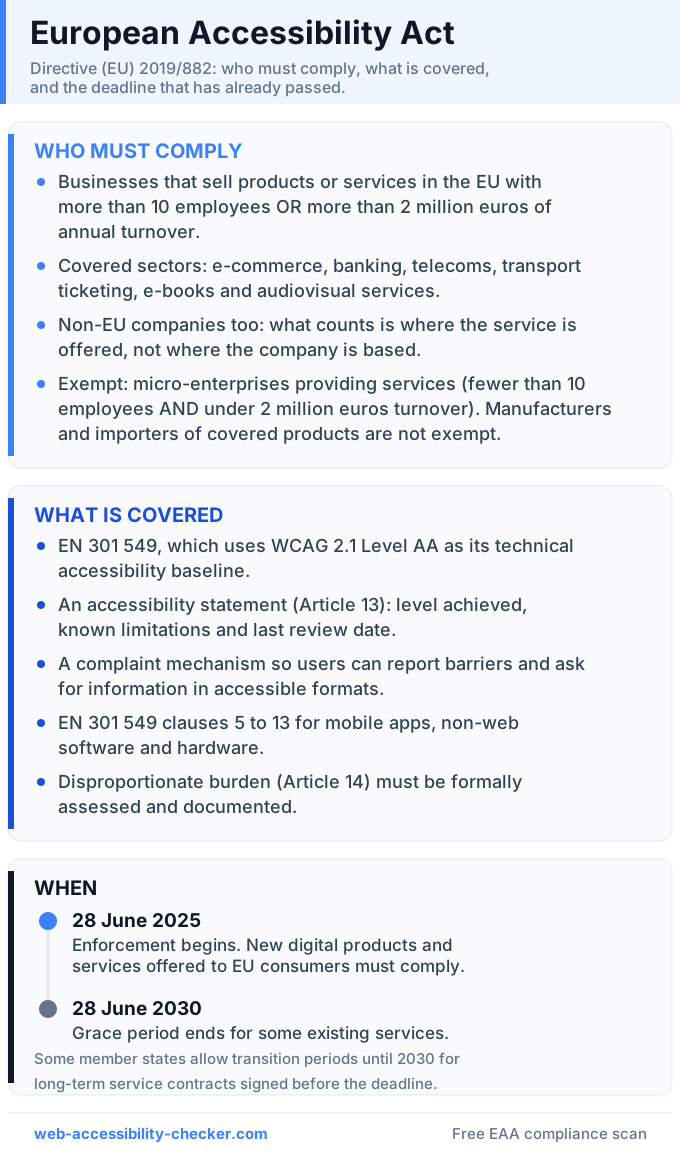
Who Must Comply?
The EAA covers businesses that sell products or provide covered services to consumers in the EU. Micro-enterprises (fewer than 10 people and annual turnover or balance-sheet total of €2 million or less) are exempt for services only, not for products. Covered services include e-commerce websites, banking services, transport ticketing, and more.
Fines by Country
Each EU member state sets its own penalties. Here are the key ones:
| Country | Maximum Fine | Enforcement Authority |
|---|---|---|
| France | €7,500 per offence (cumulative) | DGCCRF |
| Germany | Up to €100,000 | MLBF (Market Surveillance Authority of the Länder) |
| Italy | €5,000 to €40,000; up to 5% of turnover, after an AgID notice, for companies with over €500M average turnover | AgID |
| Spain | Up to €1,000,000 | Regional market-surveillance authorities |
| Netherlands | Up to €900,000 or 1% of turnover (doubled for repeat offences); duty to report non-compliance to the ACM | Authority for Consumers & Markets |
| Portugal | Up to €44,891.81 (company, very serious offence) | ASAE & sector regulators |
| Poland | Up to ~€21,000 (capped at 10% of turnover) | PFRON |
| Sweden | Penalty fee up to SEK 10M (~€900,000) | Post and Telecom Authority |
See the detailed EAA fines and enforcement cases by country for jurisdiction-specific penalty regimes and real enforcement actions.
What Does the EAA Require?
- Perceivable: Text alternatives for images, captions for video, sufficient contrast
- Operable: Keyboard accessibility, enough time for interactions, no seizure-triggering content
- Understandable: Clear language, predictable navigation, input assistance
- Robust: Compatible with assistive technologies, valid HTML, proper ARIA usage
EAA Compliance Checklist
Use this practical checklist to audit your digital service against the core European Accessibility Act requirements:
- WCAG 2.1 Level AA conformance — keyboard navigation, sufficient colour contrast (4.5:1 for normal text), alt text on images, labelled form fields, and screen reader compatibility. Use our free accessibility checker to scan your site.
- Accessibility statement — required under EAA Article 13. Must describe the accessibility level achieved, known limitations, and last review date. Generate one free with our accessibility statement generator.
- Complaint mechanism — provide a clearly accessible contact method for users to report accessibility barriers and request information in accessible formats.
- EN 301 549 additional requirements — beyond WCAG 2.1 AA, EN 301 549 covers mobile apps, non-web software, and hardware. Review clauses 5–13 if your service includes native apps.
- Verify microenterprise exemption — confirm your company status: fewer than 10 employees AND under €2M annual turnover for service providers. Note: product manufacturers are not exempt.
- Check for disproportionate burden exceptions — document any accessibility requirements you cannot meet due to undue financial or organisational burden (EAA Article 14). This must be formally assessed and documented.
Key Deadlines
- June 28, 2025 — Enforcement begins
- June 28, 2030 — Grace period ends for some existing services
Frequently Asked Questions — EAA Compliance
What is EAA compliance?
EAA compliance means meeting EU Directive 2019/882 (European Accessibility Act) requirements. Businesses must ensure digital products and services conform to EN 301 549, which references WCAG 2.1 Level AA as its technical baseline. Enforcement began June 28, 2025 across all 27 EU member states.
Who must comply with the European Accessibility Act?
The EAA applies to businesses offering e-commerce, banking, telecom, transport, e-book, and audiovisual services to EU consumers. It covers both products and services. Microenterprises providing services (fewer than 10 employees AND under €2M annual turnover) are exempt — but this exemption does not apply to product manufacturers.
What is the EAA compliance deadline?
The European Accessibility Act enforcement deadline was June 28, 2025. From this date, all new digital products and services offered to EU consumers must comply with EN 301 549. Some member states allow transition periods until 2030 for long-term service contracts signed before the deadline.
What are the fines for EAA non-compliance?
EAA fines are set nationally. Maximum penalties include Hungary (up to 5% of net revenue, capped at HUF 500 million, about €1.3 million), Spain (€1,000,000), Germany (€100,000), Italy (€40,000, or up to 5% of turnover for companies above €500 million average turnover after an AgID notice) and France (€7,500 per offence, cumulative). Most enforcement authorities issue a remediation order before financial penalties.
Does the EAA apply to non-EU companies?
Yes. The EAA applies based on where the service is offered — not where the company is headquartered. Any business offering products or services to EU consumers must comply, regardless of whether it is based in the US, UK, or any other country outside the EU.
What WCAG level is required for EAA compliance?
The EAA requires conformance with EN 301 549, which references WCAG 2.1 Level AA as its technical accessibility baseline. WCAG 2.2 Level AA is backwards-compatible with all WCAG 2.1 AA criteria and is the current recommended standard. Meeting WCAG 2.2 AA satisfies the EAA technical requirements.
What is the microenterprise exemption under the EAA?
Microenterprises providing services are exempt if they have fewer than 10 employees AND less than €2 million in annual turnover. This exemption applies only to service providers — not to manufacturers or importers of EAA-covered products such as computers, smartphones, ticket machines, or ATMs.